Showing posts with label Omer. Show all posts

Saturday, April 26, 2014

Day 11: Shabbat

Today is the day of rest, Shabbat.

I'm not going to make a long Omer entry.  Rather, make it a Shabbat!

Shabbat Omer Day 11 Journal: Take a break from writing and be with family.

Shabbat Omer Day 11 Actions:
  •  Do something restful and renewing with family and loved ones
  • Read a bit of this week's Torah portion, Kedoshim.  It has many core teachings, including the one that says, "Love your neighbor as yourself," and "Do not stand idly by the blood of your neighbor."  
Shabbat Shalom!


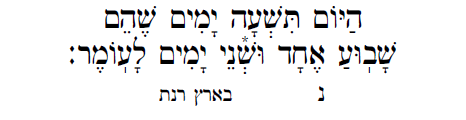
Ha-yom echad Asar yom, shehem sh'vuah echad v'arba'ah yamim la-omer
Today is the 11th day, which is one week and four days of the Omer

Omer Day 10: Israel

This week we are learning, and the topic for today is Israel.  There are so many misconceptions, partial understandings, uninformed opinions and biases that get strewn about in the public sphere about this tiny spec of land along the Mediterranean Sea.
I love Israel - I think it is an incredible country, one filled with contradictions and surprises.  It is a land filled with diverse people and ideas, floating as an island of democracy amidst a sea of . . . non-democracy.  And as a Jewish person, this Jewish state steeped in our Jewish historical roots, carries a great significance - not only as a place where any Jewish person can go to escape persecution, but also as a place where being Jewish feels natural and easy.  It is the fulfillment of a dream and a yearning that was thousands of years old, and we are fortunate enough to witness and experience it in our lifetimes.  There is so much more cultural cooperation, even across the lines of Jew and Muslim; Palestinian and Israeli than we hear about in our local news. But you wouldn't know it without searching deeper.

I may not agree with all of the Israeli government's stances and responses, just as I do not always agree with the actions my local or national government here in America.  And I see many ways in which Israel could improve.   I hope and pray for a time of peace and a time where all who live in the areas that Israel now controls can live in freedom and security, when those in the region can grow up with guitars in their hands and never need to learn how to hold guns. I also pray for a day where my smicha (ordination) as a Reform rabbi is seen in Israel as officially competent to lead a community as it represents here in America.

It is from this place of love that I want us to know more about how we can significantly help to improve Israel in the year to come.  Every few years, there is an election of the World Zionist Congress.  This is a body made up to represent all of the diaspora Jewry as a counsel to the Israeli government.  In the last election, the Reform movement's representative, Artzeinu (lit: our land), became one of the most influential groups, obtaining more seats than any other group, and building a coalition that helped to pressure the Israeli government not to give in to more restrictive conversion laws from the ultra-religious groups in Israel.  This coming year, register to vote, and do so for Artzeinu - (And note: if you are in Hadassah, there is no conflict, as Hadassah's seats are guaranteed so that its members can vote for any other group they'd like).  I'd write more, but this website has all the info you could need.  

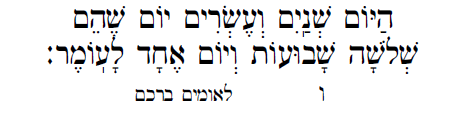
Hayom asarah yamim, she-hem sh'vuah echad u'shlosha yamim la-omer
Today is the tenth Day of the Omer

Day 10 Omer Journal: List questions you have about Israel that you'd like to explore

Day 10 Omer Action: Follow some Israeli news sources to get caught up with what is going on, on the ground in Israel.  If you have questions, send them to me!

Here are some sites I recommend for understanding aspects of Israel:
www.arza.org - the Reform movement's Israel advocacy group.
haaretz.com - my go-to Israeli newspaper that is in English
jpost.com - Jerusalem Post online - one of the most known Israeli periodicals
ynetnews.com - Online version of Yedioth Ahronoth, another widely distributed Israeli newspaper.  

I would recommend reading not just one of these sources, but read across them in order to get a deeper understanding of what the story really might be. 


Thursday, April 24, 2014

Omer Day 9: Learning

I hope the low-hanging fruits of yesterday tasted good!  I know mine have motivated me to keep going.  In fact, tonight, I have a plan to keep working at my organizing that I had started!

But before we get too carried away, we still have some planning to do.  Now that we have identified what areas we might want to focus on, what our strengths, weaknesses, resources, hopes and dreams may be, I'm recommending that we take some time to learn.  Study, research, gain new insight - when we gain acquire new perspectives, we can't help but see the world and ourselves differently.  We change when we learn.

Today's learning is aligned with the Rabbis Organizing Rabbis (ROR) group that I've been working with.  I'm going to do some learning on the topic of Immigration Reform and I invite you to do so, as well.  Here is a blog post by Rabbi Samuel Gordon, who has been a part of the Chicago group of organizers who have had some incredibly powerful (both in an emotional way and in an effectiveness-way) experiences.

I've been reading through these sights in order to further educate myself on the issues involved in immigration reform so that I can become a better advocate.  Though we are at a standstill in congress (what else is new?) it really does seem as though this is not such a partisan issue - everyone sees the need for a better set of laws, it's just a matter of what the laws are and who is brave enough to stick their neck out and stand for something, as opposed to just waiting to see what one's voter base will tolerate.  I'll list the sights below (though I highly recommend if you look at just one, go to the Reform movement's Religious Action Center, where the Jewish basis for Immigration Reform is nicely stated).

The reason our ROR group has been putting out the "I Stand with Ruth" campaign is to bring back to the collective consciousness our struggle for a better system of immigration laws.  We recently heard from a group of organizers in Chicago the story of a meeting between a local organizing group who is seeking immigration reform and a conservative congressman who came to office by affiliating with the Tea Party movement.  They brought to his attention the story of an individual who was going to be deported after being pulled over for a broken tail light.  That "crime" led the police to discover his status as a person who had come here illegally.  The problem was that his child (or children - unsure about this detail), who is/are US citizens, would be here in the US without a parent.  This congressperson stepped into write a letter to the judge advocating that the individual in question NOT be deported, so that his family could stay together.  He said it went against his Christian values to separate children from their parents. Yet, he said he felt he could not commit to larger reforms to address such problems for fear that he would be challenged by that same Tea Party group that helped him get into office in a future primary.

Regardless of how one might feel about immigration reform as a whole, a story like this one exposes the challenges our current system brings to our society.  Enforcing the law could lead to a slew of children growing up in the foster care system in America or at the very least, growing up without being able to see one of their parents - not because the parent cares little for their children, but ultimately because they care that much for their children.  This is one of many reasons to continue pushing for a system to be changed.
Ha-Yom tishah yamim she-hem sh'vuah achad ushnai yamim la-omer
Today is Day 9 of the Omer, which is one week and two days of the Omer


DAY 9 JOURNAL: What have I learned today that can help me continue to improve myself?

DAY 9 ACTION: Spend some time researching a topic that can be helpful in the quest for self-improvement, helping us to our goals.


My Journaling:

So, my learning today was geared towards immigration reform.

  • I learned of the following great site from the National Immigration Forum - it taught me that there may be some more local groups here in NC that I might be able to partner with in taking action locally.  
  • Immigration success stories like this one are getting harder and harder to find, as many of the most talented who are even studying here in the US cannot get the proper paperwork to continue advancing our homegrown companies and technological advances. 


Wednesday, April 23, 2014

Omer Day 8: Tasting Some Low Hanging Fruit

Welcome to the second week of our Omer Counting!

Now that we've accounted our inventory in various aspects of our lives, this week will be dedicated to planning.  But before we really plot things out in order to put things into action, it is important that we also taste a little low-hanging fruit.  Shavuot is still quite a while away, and we can wear ourselves out with all the reflection and planning phases so that we have no energy or motivation left to implement our strategies. We MUST avoid this at all costs!!

For those of you unfamiliar with the term, "Low-Hanging Fruit," it refers to an easily accomplished goal. There must be something on one of the lists that we've made that we could probably rectify pretty quickly and easily, and therefore "taste" the reward of accomplishing something without making a monumental effort. Go back and scan your journals, find a task that is low effort/high reward . . . if you only have high-effort items, then pick a piece of that idea and go for it.  If I have the goal of cleaning off my piles on my desk, which might take too much effort to do well, then maybe today I clear off one pile.  And if you haven't kept up with it, no problem, brainstorm an easily achievable goal that can be done today and feel really good about having checked it off your imaginary list.

This is one of the reasons we cling to ritual in Judaism. If we are constantly striving for lofty ideals - the kind of personal growth that takes an entire lifetime, we might all become jaded and disparaged over time.  We might give up the pursuit.  So, along the way, we focus in on easily achievable rituals that provide us with structure for our journeys, re-focus our long-term goals, and push us back towards becoming the person each of us hopes to become (and at the same time bring us in contact with one another, lift our spirits with liveliness and food, and help us break the monotony of time that can lead us to states of atrophy).  This Omer period, for instance, is one of those ritualistic invitations.  The low-hanging fruit is just the recitation of the omer blessing, and the pause in doing so.  The fuel we get from its sustenance, though, can help us reach for bigger and better pursuits in ourselves.

Here's to filling us up as we continue to reach higher and higher!

Day 8 Omer Action: Pick a low-hanging fruit and cross it off your to do list!

Day 8 Omer Journaling: Describe how your low-hanging fruit is part of a bigger goal you have for yourself.


Friday, April 20, 2012

Making Today Count


            In this season just following Passover, our tradition invites us to embark on a spiritual journey of finding meaning through the counting of the Omer.  Each day for the 49 days between the start of Passover and the holiday of Shavuot, we are instructed to make an offering.  According to our Torah, this offering was to be an Omer (a specific measurement) of barley.  Today, this period of time calls upon us to find our own source of Omer. 

            We are reminded that each of us has the potential to offer something new to the world every day – to impact another person, to stand up for those who need defending, to advocate for our core values.  At this time of year, we strive to do so consciously, not letting a day go by where we have failed to bring some kind of intentional offering of ourselves.

            While we impact our world, we are also reminded that the barley that was offered in ancient times was not of us but of the earth.  Part of the Omer involves recognition of the gifts that this world has to offer us.  During this period, let us seek out moments of appreciation for the world in which we live.  Let us take time to note and find those elements of our lives that we might take for granted and spend a few moments in gratitude.  Doing so might just offer us the perspective we need to positively and intentionally impact our world.

            In light of this time of year also bringing Yom HaShoah – our day of Holocaust Remembrance – we must be reminded the importance of making each moment count.  By living out this Omer message, we declare to the world and to our ancestors that despite the best attempts of those who tried to wipe out our people, we are still here striving for tikkun olam, the repair of our world, according to our Jewish values.                         

Today is the 13th day of the Omer. 
·      How will I make it different from the previous days? 
·      What will I offer to the world on this day? 
·      What offering does the world have for me? 

If we can find positive answers to each of these questions today and every day of the Omer, our world will be transformed and lifted up.

-       Rabbi Ari N. Margolis
Omer 5772


One way to make an immediate offering to our world is to join with us in opposition to the proposed marriage amendment to the NC State Constitution.  Be sure to vote on or before May 8th.  Talk about it to friends and neighbors.  For more ideas on how to advocate, visit www.equalitync.org


Tuesday, May 24, 2011

Day 35: Leadership in Humility

Today is Day 35 which is five weeks of the omer . . . Ha-yom shloshim v'chamesh yamim, she-hem chamishah sh'vuot la-omer.


THE OMER INTERSECTION: Chod + Malchut - Humility and Leadership
As we wrap up our week of humility, we have hopefully worked on letting go a little bit more of our egos, which has hopefully helped us to recognize the part of ourselves that is a part of something bigger that we care about.  I know for myself, I've thought about how I am as a husband, a parent, a rabbi, a son - all sorts of roles - and done a little bit of separation between what I make about me in each of these roles, and what I do that is not about me at all but about these relationships. 
Now we turn the tables of such exploration specifically to the area of leadership.  How do we use our humility to lead?  What I've been finding through these reflections is that it takes a quiet confidence to be humble.  When we have insecurities in our egos, this is when we have the most trouble achieving humility.  In such situations, we tend to need feedback in order to feed our sense of self - to receive validation or support or confirmation that what we are doing is good and appreciated. 
When we are unable to fill ourselves up with what we are doing, it is hard to have true humility about our actions, since we feel the need seek out affirmation.  My mentor from the Rhea Hirsch School of Education at Hebrew Union College in Los Angeles, Dr. Michael Zeldin, once met with me to discuss how I was doing in an internship, and we spent a good deal of time talking about confidence.  He asked me where my confidence comes from, and at first I responded with feedback from others.  And he helped me to understand that confidence has to come from within based on being able to analyze one's own actions with the tools of a plethora of theories and best practices.  We take feedback in as a means to assess the work we are doing, but that should not be a referendum on the person we are.
When we have a quiet confidence that comes from within - a sense of who we are, even as we are willing to openly question and analyze and improve upon the work that we do - the feedback we seek becomes more about our shared purposes than about our individual needs.  And this is what it means to lead through humility.  As we ask questions of others and relate to others in the course of trying to make things happen in our world, the key is to not make such interactions about us, but to keep focused on the tasks at hand.  And when we model this in our leadership roles, we lead through humility. 

THE OMER CHALLENGE:
Today is a day to work on our self-confidence.  Think back to the paper-slip activity and focus a bit on the building-up side: "For my sake, the world was created."   Spend a few moments just taking-in an aspect of our world that reminds us that "For my sake, the world was created."  Let this experience remind us that we have positive things to experience in this world and to contribute to it, and that we are worthy of living up to our responsibilities.    
As a VERY BROAD CHALLENGE (I wish I had ideas for how to make this more measurable and concrete, but nothing's popping up and it's time to get the post out).  During the course of the day, in the tasks we attempt, let's work on separating out the validation we crave for our own sense of self from the feedback we need in order to evaluate what we do.  Let us hear feedback openly and not conflate it with who we are but rather allow it to inform what we do.  Practice this, and see if it works for us.  This way, we can be more open to questioning the ways we approach our tasks in ways that might allow us to go about our work/projects/relationships with a bit more humility.  And we might inspire others to do so, as well.

Sunday, May 22, 2011

Days 32, 33, and 34: LOTS of humility (And Lag B'omer - the big break of the Omer)

Today is Day 34 which is 4 weeks and


SO, I guess on the weekends blogging gets tougher  - with the different schedule and with the fact that as a rabbi, I've been working most of the weekend, and I'm still learning that balance.  But rather than just move past the last couple of days.  Though I haven't written about them yet, they have a lot of meaning, so I'll incorporate them all together in this post.  


THE OMER INTERSECTION: Chod + Nitzach, Chod, and Yesod - Humility mixed in with endurance, humility, and today's actual intersection, bonding:


As we build back up to today's intersection, let's at least run through the others from the past few days: 
Humility and Endurance - What are the challenges to sustaining our humility?  When are there moments in which we are tempted to ignore our humility and act with brashness?  Do these lapses in humility take us away from the person we are trying to be? Sometimes, we choose in the short term to respond with ego instead of taking a step back and allowing our humility to give us the patience to endure.  One of the most common scenarios in which we respond in such a way is the inclination to say, "I'll just do it myself" when someone else struggles, doesn't fully follow through, does something differently than we would, etc.  There is nothing humble about "I'll just do it myself," even when we think we're doing it to be helpful to others.  Not that there is never an appropriate time for such a response, but we probably all do this more often than we should.  


Humility and Humility - What holds us back from being humble?  Is it the vulnerability of allowing myself to reflect and see where I may have made mistakes as opposed to blaming everything on someone or something else?  Do I see my humility as central to my ego, making it not so much an expression of letting go of ego, but rather making it a central part of who I am?  When we are humble because we think we should be, we are making our response about us rather than about the bigger issue going on.  This intersection from the lag B'Omer (which was today - more on that soon) requires us to remember to keep our focus on that which is outside ourselves


Humility and Bonding - Sometimes, when we respond from a place of  humility, we can feel a bit lonely.  To walk a path of humility sometimes requires us to suppress certain things we might want to say but would not be productive for our cause, our community, and ultimately ourselves.  Examples of such experiences include times when we hear private things about someone else that the other would not want us to share or when we end up looking bad when someone else does not follow-through as expected.  To share such details would make us feel better in the short-term, but we might regret such actions later.  Our intersection for this evening and Monday challenges us to rethink our reactions to such situations.  We have to recognize that in such cases, the drive to share with others can be a bit more about our own egos.  Because we are so worried about that part of ourselves, we might feel alienated and separate when acting on our humility.  But, if we let go of the ego, chalk it all up to a part of the bigger picture, and act in ways to support others and work more closely with others, these moments of humility can actually bring us closer together.  


THE OMER CHALLENGE:
For this day, when we have a moment in which we are tempted to assign blame to someone or something else, stop.  Whether in speaking to someone else or just in contemplating a situation for ourselves - let us instead take responsibility for being a part of the solution, working with others and bringing them closer.  Excuses can push people away, even when legitimate.  There are times for excuses, but for today, let's not make this one of those times.  


Shavua Tov!


Friday, May 20, 2011

Day 31: How Compassion Can Help Us Reach Humility?

Today is Day 31, which is four weeks and three days of the Omer. . . Ha-yom echad u'shloshim yom, she-hem arba'ah sh'vuot u'shloshah yamim la-omer.


THE OMER INTERSECTION: Chod + Tiferet - Humility and Compassion:
Humility and compassion seem like they are already companions.  As we're seeing this week, humility is all about our ability to shift our mindset to thinking about how a moment is all about me to how a moment is about something bigger than myself.  It is about seeing the privilege in being a part of, as opposed to taking for granted that such moments in life just happen.  To reach such a state of humility, we have to reach outside ourselves, and this is what tiferet, compassion, pulls at us to do.
While we have also been exploring the boundaries in which too much chod can suppress us and can overly diminish our sense of self, today's intersection calls out to us to actively pursue the times in which we are not finding enough humility.  It is our sense of compassion that has the potential to move us out of our self-important bubbles and towards finding greater meaning outside of ourselves in all aspects of our lives.

THE OMER CHALLENGE:
So, today, let's work on our humility.  If we followed through with yesterday's paper-slip challenge (more on that in a bit), we may have found a few places in our lives where we realized that more humility might be a good thing.  Let's pick an area our lives in which we could use an extra dose of humility, and open our hearts to feeling compassion for others.  If we need to do this as a spouse, then spend time listening and openly inviting our partners to share with us, and as we listen try to experience the discussion from their perspective and point of view, and not how it makes us feel.  If we need the humility at work, let's seek out and listen to the ideas of others and genuinely consider what they have to say, seeking to find merit rather than listening just to shut it down.  Wherever we need it, let's work to bring that humble approach to our lives.

OMER REFLECTION: The Paper-slip challenge
I have to admit, I really LOVED the idea to actually put the pieces of paper in each pocket from yesterday.  I had to look at the "dust and ashes" slip a few times just to remind myself that the concept for this experiment was not my own, but based on century-old wisdom passed along to us.  For the most part I followed-through on the exercise, and I absolutely learned a few things about myself and about humility:

1) I think of myself as a humble person.  I don't crave the spotlight unless it is about a bigger cause than myself, I constantly and consciously fight to ensure that what I do is more about values and the needs of those I love and serve rather than my own ego, and I can be genuinely hard on myself.  I had expected to be reaching into the "world for me" pocket more often than the "dust and ashes" reminder.  But the opposite was true.  Maybe this is just what I do all the time to keep my ego in check, but it was an important self-realization.  (In fact, I just reached back into the "dust and ashes" pocket to remind myself that while I am definitely doing self-reflection here for self-growth, this blog space is also for others and I shouldn't just make it about me.)

2) Humility is all about an appropriate balance.  A number of times, I found myself reaching into one pocket, only to then feel the need to reach into the other!  For part of the day yesterday, we were shooting a video for the last day of religious school.  We were dressed in ridiculous costumes, and I figured, if I'm going to embrace the embarrassment and silliness of this moment, I needed the self-confidence "world for me" reminder.  As I did so, I then thought, "But I have to keep in mind that as fun as I'm having while doing this, it's not about me - it's about creating a moment for the kids in the religious school.  So, I reached my other hand in the other pocket and grabbed both slips of paper at the same time.  I found this happening a number of times during the day..  

3) Doing such a concrete, ongoing, accessible activity throughout the day really helped me gain consciousness about my thoughts and actions.  It did so in a wholly unexpected way.  Of course, there were times during the day when I forgot I even had the papers, but then I'd get back on track, and each time I had to decide, it brought a whole different awareness of the moment at hand.  I learned so much from this experience, that I have the papers in my pockets again today, hoping to continue to grow from it all!

Thursday, May 19, 2011

Day 30: A Pocket Experiment - Humbly Seeking Discipline and Our Voices

Today is Day 30, which is four weeks and two days of the omer . . . Ha-yom shloshim yom, she-hem arba'ah sh'vuot u'shnei yamim la-omer.


THE OMER INTERSECTION: Chod + Gevurah - Disciplined humility:
Today is an odd couple.  Chod and Gevurah - discipline in humility.  They don't seem to go together much, as humility has always struck me as a virtue that comes about organically.  But I guess this is why today's intersection has great significance, because we do not always spend a great deal of energy actively pursuing and honing our humility. 
So, the first question should be, in what ways do we need discipline/focus in our humility?

There is a rabbinic saying attributed to 18th-19th century Rabbi Simcha Bunim of Peshischa (a town in Poland), that: at all times one should carry two slips of paper, one in each pocket. When we have a moment in which we are feeling down on ourselves and low, we reach into one of the pockets to pull out the slip of paper that has the Talmudic statement, "For my sake, the entire world was created" (Babylonian Talmud Sanhedrin 38a).  And at times in which we are feeling really high on ourselves - maybe a little too high, we reach into the other pocket to find the paper that has the words of Abraham, "I am but dust and ashes" (Genesis 18:27). 
Perhaps this is the discipline we need - to be aware that there are times for humility and times to subdue our humility in search of our voice - the words and sounds for which the entire world was created.  
We each have our tendencies - towards brashness and self-importance or towards humility.  And we may experience each in different areas of our lives (i.e. put me in a conversation about baseball strategy, and I need a major dose of humility in order to listen to someone else's perspective and to avoid coming across as a know-it-all.  Ask me to speak for a cause, and I need to remove my self-doubts and my excess humility to find my voice that can speak to the moment at hand).  Gevurah demands that we harness our own tendencies to be able to apply the appropriate amount of humility for the task at hand for the individual who needs it.  

Now, the caveat here is that we should never lack humility altogether.  Even if we have to fight ourselves to go out and find a voice and speak it to others - in a relationship, in the workplace, on stage at a performance, even in a job interview - we should always do so with a humble approach.  The moment does not need to be about me, but about the shared experience we are facilitating.  Our humility draws us to understand that we have the potential to be a vehicle through which events in this world can happen.  Other people could also be that person to do this, but at this moment, I'm the one who is here.  With such a disciplined approach, we have a greater chance at successfully engaging others in the task at hand.

THE OMER CHALLENGE:
So, I shared a story about the two slips of paper.  I LOVE this story.  I even have a tallit (prayershawl) that has these two expressions written in Hebrew on the corners of the tallit, so I can keep this in mind while I pray and while leading others in prayer, as well.  

Today, let's put this story into practice.  Try it out, LITERALLY!  Let's experiment. I am currently writing down the two expressions on two slips of paper: "For my sake, the entire world was created,"  and, "I am but dust and ashes."  And now, I am putting those papers into my pockets.  Let's each do the same and over the course of the day, when we need it, take out the appropriate statement and look at it (or at the very least, touch the pocket with the needed slogan and re-adjust the level of humility).  Pay attention to how often and in what situations we turn to each statement.  As I write this, I'm taking out the "dust and ashes" statement, as I'm very aware that I am audaciously asking you to do some crazy kind of exercise.  And I need to keep in mind that my request is not for my benefit, but an offer to you to take it on as you would for your own sake, not mine. 

Happy humbling (and un-humbling)!

Tuesday, May 17, 2011

Day 28: Putting Endurance into ACTION - Speaking at the State Legislature

Today is Day 28, which is four weeks of the Omer. . . Ha-yom shmonah v'esrim yom she-hem arba'ah sh'vuot la-over
  

This is the last day of our week of Nitzach, endurance.  And as a culmination, I was able to put all of our lessons this week into practice by speaking this morning at a press conference at the North Carolina State Legislature in defense of marriage equality and domestic partnership rights for all, in particular for those who love someone of the same gender.  I'll share more about the challenges involved, and why this was an application of my own endurance in the intersection below, but it is pretty amazing that the opportunity I had to walk my values today and put my prayers into action coincided with today's omer intersection:

THE OMER INTERSECTION: Nitzach + Malchut - The Leadership of Endurance
Today, we look at the way we use our endurance for leadership.  We all take on leadership roles in some area of our lives, whether it is in our family lives, our work roles, amongst our circle of friends, or just in making a quick decision as to where to meet up with someone else.  Sometimes, we may want to shy away from this leadership role, even when a leader is most needed.  And at these times, we must endure - beyond our self-doubts, our discomfort, our lack of an ideal situation - and lead. 
This is what happened with me today.  

In North Carolina, there are currently bills being considered in both the house and senate chambers to amend the State Constitution by defining marriage as between a man and a woman.  The senate bill goes even further by also denying rights of domestic partnership to any same-sex civil unions.  A number of church groups had planned on bussing their congregants from across the state to attend a rally against same-sex marriage this morning.  In order to have a strong voice against this legislation and a religiously based voice to help people avoid making this into a religiously-based political issue, Equality NC, through the help of State Representative Marcus Brandon, arranged for a press conference for clergy in support of LGBTQ rights.  

I was asked to speak at this press conference. Though this has been an issue dear to my heart and my values, it was not the easiest decision for me to make.  I have never done anything like this before, so I had my own self-doubts - am I good enough? Why me?  Why not someone else?  There was very little advance notice, especially as to the fact that I was going to a speaker and not just in attendance, could I prepare in time?  I had a schedule to re-arrange, etc.  Challenge after challenge, big or small, they all add up in the moment of having to make a quick decision.  Fortunately, I was able to endure beyond all of these challenges of scheduling, lack of advanced notice, self-doubts so that I could go ahead and do something worthwhile that enacted the values of equality, justice, and that I hold dear and that are espoused by Reform Judaism.  

And fortunately, I have incredible mentors in Temple Beth Or's senior rabbi, Rabbi Lucy Dinner, who gave me the opportunity to be in touch with Equality NC (who could not go because she was at jury duty) and in Rabbi Denise Eger (who happens to be at the White House today on an invitation in honor of Jewish American Heritage Month), who coached me through what to say at such an event.  See - find a partner who can help you to endure!   

Below, you can see what I said at the press conference, and in addition, you can find the statement that I read on behalf of the more-than-a-dozen clergy from all over the state who came in just to stand behind the sentiments being promoted.  If you are a person of faith or a leader in a faith community who would also like to add your name to this statement, you can do so here:

One of the core tenets of my faith and of our shared faiths is the demand from our traditions, ahavtah l'reiechah camochah - love your neighbor as yourself.  
As a rabbi, my support for gay rights and marriage equality is a result of my faith.  Reform Judaism has supported equality for those who are gay and lesbian, stemming from the belief that all people are created b'tzelem elohim, in the image of God.  Sexual orientation is irrelevant to the worth of a person. The legislation currently being proposed prevents Reform Jews along with many other people of faith whose traditions hold similar values from being able to fully practice our faiths.  
Therefore, religious leaders and people of faith across North Carolina have joined together to declare that:


The most fundamental human right, after the necessities of food, clothing and shelter, is the right to affection and the supportive love of other human beings. We become most fully human when we love another person. We can grow in our capacity to be human - to be loving - in a family unit. This right to love and form a family is so fundamental that our United States Constitution takes it for granted in its dedication to "secure the blessings of liberty to ourselves and our posterity.” The North Carolina Constitution likewise affirms the “inalienable rights” of human beings to "life, liberty, the enjoyment of the fruits of their own labor, and the pursuit of happiness."

As people of faith, clergy and leaders in our faith traditions, we are mandated by God to demonstrate and protect love in all its forms and to stand for justice for all of creation. In faithful response to this calling, we commit ourselves, along with thousands of other Christians, Jews, Muslims and other people of faith around North Carolina, to these basic principles:

  • While we respect the fact that debate and discussion continue in many of our religious communities as to the scriptural, theological and liturgical issues involved, we draw on our many faith traditions to arrive at a common conviction. We oppose the use of sacred texts and religious traditions to deny legal equity to gay and lesbian couples.

  • We insist that no one person or institution, especially the state, is allowed to define the God-given covenant of marriage or bar two consenting adults, whether of the same or differing genders, from forming the family unit that lets them be more fully loving, thus more fully human.

  • We oppose any amendment to the North Carolina Constitution that would prohibit gay and lesbian couples from receiving the protections like health benefits and hospital visitation afforded by legal recognition of their relationships. Likewise, we are further resolved that the State should not interfere with gay and lesbian couples who choose to marry and share fully and equally in the rights, responsibilities, and commitments of civil marriage.

  • We affirm freedom of conscience in this matter. We recognize that the state may not require religious groups to officiate at, or bless, gay and lesbian marriages. Likewise, a denial of state civil recognition dishonors the religious convictions of those communities and clergy who officiate at, and bless, gay and lesbian marriages. The state may not favor the convictions of one religious group over another by denying individuals their fundamental right to marry and to have those marriages recognized by civil law.

As people of faith, we urge the North Carolina State Legislature to protect families in North Carolina by opposing the anti-LGBT constitutional amendment.  

We also call upon you and all people of faith to join the over 300 religious leaders who have already signed a statement against this type of legislation.  You can do so at www.equalitync.org/faith


THE OMER CHALLENGE:
Right out of the Spiritual Guide for the Omer, today's challenge is:

"Fight for a dignified cause."  

May we all endure through all the challenges to doing this one and find our leadership in a cause about which we care deeply.     

Monday, May 16, 2011

Day 27: Bonding with our Endurance

Today is Day 27, which is three weeks and six days of the Omer . . . Hayom shivat v'esrim yom, shehem shloshah shvuot v'shishah yamim la-omer.


THE OMER INTERSECTION: Bonding of Endurance - Nitzach + Yesod
Usually, when we think of bonding, we think of our personal connections with other people.  The time we spend together, the memories we create, the feelings we foster that become our lasting impressions when we think of other people.  When we are talking about endurance towards some of our goals, the value of yesod, bonding, teaches us that in order to stick to a new plan of action - a new, healthy habit formation - we need to bond with our task-at-hand.  It is one thing to say that I want to work out more often.  But it is another thing altogether to actually spend some time with the idea - imagining ways to accomplish the task (different ways to get-in physical activity: gym time, running, playing sports with friends, etc), sitting down with one's calendar and actually finding time to plug-in dedicated moments to spend with the task (blocking-out morning or evening or even midday hours in the calendar for workout times), and finding allies to help us in the endeavor (finding a workout buddy, making public statements to others about the times we plan to spend exercising, making us feel accountable not only to ourselves, but to others, as well).  Today, we are called upon to bond with our big goals, so that we can find a path of endurance to lead us there.


THE OMER CHALLENGE:We've been identifying various goals all week to sit with and find ways to endure towards.  Whether it's an old, on-going goal or a new one that we're picking, let us spend some time today bonding with one.
1) Spend some time plotting some "low-hanging-fruit" - some easily achievable, no-brainer tasks that get take a few steps towards our goal, so that we get a bit of an experience with which to bond with our goals.
2) Calendar-in these "low-hanging fruits," and put time into the calendar for the next three weeks out.
3) Tell your ally that we identified earlier in the week.  If you skipped that step, then pick an ally in the endeavor, and recruit their help now.  It will not only bond you to the task, but will help bond you to the person you choose to share this journey with, as well.

OMER REFLECTION:
It's nice to be reflecting on these values again.  And though I may not be as timely with the posts as I'd like to be, I think I'm gaining all sorts of appreciation for taking conscious steps to ensure my own endurance.  One lesson learned is that sometimes it is okay to let go of perfection in order to endure with the plan.  I would not call myself a perfectionist, but I do take pride in having a certain level of quality in what I do.  While I see this as a strength of mine, I have found that it can also be a convenient excuse for not enduring when I allow my definition of 'quality' to be too strict.  Using the blogging as an example, I was trying to get each post out in the evening, which proved to be too burdensome for my schedule on some days.  If I started to fall behind, rather than write a little late, I was put-off by the burden of it not being "on schedule."  But forcing myself to write, regardless of the timing, and get back on track with the counting has helped me to continue to use this time as a time of growth, which was the primary intent.  It's also inspired me to follow through with some real social justice work that I might otherwise have shied away from, but more on that in the coming days. . . .
I'd have written this all in the "we," but I didn't want to put words in anyone else's mouth if you have different experiences of this lesson.  But any thoughts you have with a different perspective or a similar one would be welcomed! 

Day 26: Humility in Endurance

Today is Day 26, which is three weeks and five days of the Omer . . . Ha-yom shishah v'esrim yom, shehem shloshah shvuot v'chamishah yamim la-omer
 

THE OMER INTERSECTION: Nitzach + Chod - Humility in Endurance
In the midst of our endurance, we can sometimes get too wrapped up in our own sense of ego that we see our perseverance as a source of personal achievement and ability.  Doing so can cause us to develop tunnel vision for a particular path of our choosing and might blind us from other possible ways of going about our task that might work better for us or for others.  This is where chod comes in - as a means to remind us that we may not always know everything, and it is okay to look outside oneself for ideas/advice/inspiration.  Our chod keeps us flexible in the face of obstacles and challenges to our endurance towards an ultimate goal.

THE OMER CHALLENGE:
BE FLEXIBLE.  At some point, today, at a moment in which we normally would find ourselves to be upset, let's catch ourselves, allow our sense of chod to check our egos, and be open to trying a different path through the challenge.

Friday, May 13, 2011

Day 24: Compassionate Endurance

Today is Day 24 of the Omer, which is three weeks and four days of the omer. . . Ha-yom arba'ah v'esrim yom she-hem shloshah shvuot u'shloshah yamim la-omer


THE OMER INTERSECTION: Nitzach + Tiferet - Enduring with Compassion
I loved what the Spiritual Guide to the Omer has to say about today: "The compassion of endurance reflects a most beautiful quality of endurance: an enduring commitment to help another grow. Endurance without compassion is misguided and selfish." What a great insight!  It is true that often, when we face challenges, we become very selfish.  Sometimes, it takes all of our brainpower, willpower, and power-power (strength) to endure in our quests.  The easy route is to focus back on my own needs to find a way through the challenge.  Afterall, The famous Rabbi Hillel (not the college campus organization) asked, "If I am not for myself, who will be for me?" (Pirke Avot 1:14). When we experience those bumps in the road, we are our own best advocates.  If we aren't willing to commit to getting through the challenge in order to keep on going, who will do that for us?  Usually no one.  Endurance requires a bit of this self-focus.
Ah, but that's where the compassion comes in - Hillel's next question states: "If I am only for myself, what am I?"  Our endurance can cause us to look so fully inwards that we fail to reach that sense of chesed with which we started our journeys.  Often such tunnel-vision takes us away from the person we are trying to become through our endurance. 

THE OMER CHALLENGE:
To avoid falling into the trap of being overly self-consumed, let us embrace the challenge that our intersection calls for and show compassion for someone who we tend to view as an obstacle or hurdle to our personal goals.  Whether it is a boss or a friend or an acquaintance, a co-worker, or the driver in the next lane, when we start to feel that someone else is infringing on our abilities to move towards our goals, when we get into the mindset that we just have to endure this person standing in front of us, let us take a moment to remember that the other person is a human being, as well, with their own hopes and dreams and needs.  (Sorry for the INCREDIBLY long sentence).  Let us be that much more conscious of how we are treating them, even if the favor is not returned.  In that way, we can remain the person we hope to be and not let the other dictate our behavior.  If we're able to do so, our compassion just might actually help us to endure in our lifelong quests to be the best "us"es we can be.

THE OMER REFLECTION:
So, as a re-commitment to this blogging, I took to heart some of my own advice and analyzed whether or not some of my "habits" were actually preventing me from enduring with discipline.  And I came to a few conclusions:
1) I have to manage my time better where possible so as not to allow this post to happen only in the middle of the night.  I am bound to have a middle-of-the night blogging episode here and there, but I can't make it as consistent as it was.
2) Even though today's entry is in my original structure, I need to let go a little bit of the need to have three distinct sections.  So, be prepared, we might not have this same format every post.  And that should be a good thing!
3) I am finding that even when I don't think I have a lot to say about a value intersection, I do.  So, I'll need to fight my verboseness (verbocity?), and focus a little more. This should help with the amount of momentum I have to overcome in order to start a post.  Once I'm writing, it's wonderful.  Oh, Newton and your laws of momentum - why does the fact that bodies at rest tend to stay at rest have to apply to the process of writing, as well?!
All in all, it's good to be back!
Shabbat Shalom tomorrow!

Day 23: Enduring with Discipline

Today is Day 23, which is 3 weeks and two days of the Omer . . . . . . Ha-yom shloshah v'esrim yom shehem shloshah sh'vuot u'shnei yamim la-omer
 

THE OMER INTERSECTION: Nitzach + Gevurah; Endurance with Discipline
One of the ways we find to endure towards our goals is by developing habits.  I remember when I was playing baseball, I would go into the batting cages and hit ball after ball, swing after swing, trying to develop a body motion that would allow me to get the bat on the ball without having to think about it.  My physical motion became a reaction that we call a "swing."  And rather than thinking about how to move my hands and wrists and arms and waist and legs all together as a ball flew towards me, my swing just happened.  All I had to think about was whether or not to swing in the first place (and that too needed to be trained into a bit of a reaction, as well).  My swing was my habit. 
By the time I got into higher levels of baseball playing, the balls from the pitcher came faster, and I had to decide sooner whether or not to implement my swing.  When my hitting started to fade, my coach took a look at my swing.  That habit I had developed over all the years of hitting was starting to betray me!  My coach noticed that I was making some unnecessary motions - a "hitch," he called it - in my swing.  He worked with me to re-focus on the mechanics of hitting the ball - the path from which I sent the bat from above my shoulders to the point of contact.  I would do half-swing after half-swing, shortening the motion into more of an ax-chopping than a roundhouse, keeping the head of the bat from dropping too far.  And eventually, I had erased my old habit of a swing and incorporated a new one.  That year, my statistics improved dramatically (as did my playing time), and I learned about the intersection of our two values today.
Sometimes, our endurance can actually get in the way of our discipline.  In this story, my original habits actually took me further away from my goals, because I was not disciplined at ensuring that I was swinging properly in the first place.  When conditions changed, I did not, and therefore, I was almost left behind. 
The  Spiritual Guide to the Omer asks, "Do I use my endurance against itself by being tenacious in my lack of determination?"  I saw in this question the following question, "Do we sometimes allow our habits to get in our way by refusing to re-visit them?" We have to be disciplined in our endurance and open to changing our habits so that we can truly live out our long-term goals.       
 
The OMER CHALLENGE:
I really liked the challenge from The Spiritual Guide to the Omer: Break one bad habit today.  Now, I know that is a bit vague, and it is MUCH easier said than done.  So, I'll offer a little bit of a pathway towards this goal, and I'll attempt to follow it myself, too. 
1) Identify a habit to change
2) Actually write down three actions to take in order to help re-train yourself
3) Put it in your calendar to re-visit this action list two days from now, a week from now, two weeks from now, three weeks from now, and a month from now.  And for good measure, put it on for two months, three months, and six months, as well. 
4) Follow-through with the actions and the reflections
5) If needed, seek help from someone else.

Disclaimer: While I know this post is a little late, it was written and ready to go DURING the 23rd day!  But the website hosting this blog was down.  We'll cut them some slack, because it is an incredible service provider who makes the ability to post to this site incredibly easy.  And I hope we all found a way to endure without the on-time posting!

Wednesday, May 11, 2011

Day 22: Getting Back In the Saddle - this time with ENDURANCE!

For those of you following along my journey in counting the omer, I owe you all an apology.  I have been off-track the past few days, counting the omer on my own (my wife can attest to that!), but not able to post my semi-rambling, sometimes insightful omer dealings.  It was the week of compassion, and I took compassion on my family and myself by focusing a bit more on other aspects of life that were being neglected.  At least, that's how I justified it to myself.  But while I can apologize in words, I will try my best to do so in action by re-committing to this blogging of the omer

But, I made a commitment, and though I have already fallen off of the goal of an update-a-day, it does not meant that I have to leave the whole project behind.  So. . . 


Today is Day 22, which is 3 weeks and one day of the Omer . . . . . . Ha-yom Shnaim v'esrim yom shehem shloshah shvuot v'yom echad la-omer
 
Now, isn't this appropriate? We're picking back up during the week of endurance.  It's time now to focus on aspects of our lives in which we need to work on determination, patience, vigor, vision, follow-through, and focus in addition to any other values that help us to continue to travel towards our goals, even when we fall short, struggle, or see the end as VERY far away. 

THE OMER INTERSECTION: Nitzach + Chesed;  Love in endurance
Well, isn't this appropriate?  We've just in time to move on to our next week: Nitzach - endurance.  As a Cubs fan, I know a lot about endurance.  We all commit ourselves to people, projects, goals, and even TEAMS that we know are going to require us to give a lot of ourselves, and we may not know how long it will take to get to the desired outcome/relationship/World Series.  When challenges to those goals arise, if we value our long-term outlook that much, then we have to find a way to endure through the difficulties.  (Oy, I am so disappointed in myself as I write this, but now I need to find a way to endure). 
The first step of figuring out how to endure comes at us with today's omer intersection.  Often when we get into the nitty-gritty of performing the tasks that build towards the ultimate goal, we can lose sight of why we set out to do so in the first place.  Most of the time, as we learned in our week of discipline, gevurah, we commit ourselves out of love.  And this is one of the first places to look when we need to find endurance, as well.  Our chesed is a vital component to reminding us why we set out on our paths in the first place.  If we can spark that sense of love back into our hearts - seek out an element of joy in the tasks at hand that remind us of the reasons we need to endure - then we can find our Nitzach and continue on! In addition, our chesed can help guide us when we find that the ways in which we have been trying to endure may not be the healthiest of best approaches. 
THE OMER CHALLENGE: 
So, how do we apply this idea? Well, I'm working on it right now with this blog entry.  Over the past few days, the idea of counting was pretty empty without the writing and reflection that came with it.  As I type and return to reflection, I'm being reminded again of all that I had been gaining as a result.  At the same time, I may have needed this hiatus and extra time in my day in order to be all the things I was trying to become, especially during the week of compassion.   
For today, the challenge is two-fold: 
1) Let us identify a commitment with which we are struggling.  Take out a sheet of paper and actually write down three reasons we started down that path in the first place.  If the reasons do not include any aspect of love, then we either need to keep searching, or we may need to re-evaluate our commitment!
2) With this same commitment, take a step back and access that bit of love that we find.  Let's reflect on our actions of late and see if we need to find a different pattern of action to help us stay on task. 

OMER REFLECTION:
So, I hope to offer some additional thoughts on compassion at some point.  Perhaps I can make teshuvah, repentance, for the missed days of compassion by exploring them additionally after the omer officially ends.  I'll figure a way forward with that one - both for all those of you who are reading and journeying with me and also for myself to be able to get that sense of endurance and dedication, nitach and gevurah, that I have sought with this project.
I did realize, though, that time away sometimes helps us to value what we have.  And now that this post is coming to a close, I am once again excited by the opportunity to reflect, take a step back, and choose my concerns more consciously than I do when I do not make the time for such structured reflection.  Let's hope that you, too, can find that same space within the rest of the omer!

Friday, May 6, 2011

Day 17: Compassion Squared

Today is Day 17, which is 2 weeks and three days of the Omer . . . . . . Ha-yom shivat asar yom, she-hem shnei sh'vuot u'shloshah yamim la-omer.


THE OMER INTERSECTION: Tiferet + Tiferet;  Compassion Squared
Compassionate compassion.  When we experience compassion, we can often feel compelled to help others.  It is often a starting point for our desires to make a difference in this world.  When the world pulls at our heartstrings, and we get the urge to help, it is important that we check our compassion with more compassion.  
Wait, what?  Yes, this is the intersection of our day - what does that mean to check our compassion with compassion?
At times, our urges to help come more from our own feelings of guilt that there are others suffering while we are not.  And we end up reaching out in ways that are more about ourselves and what we think is needed than if we listen to the other and reach out according to what the real need may be.    

THE OMER CHALLENGE: 
So, how do we apply this idea?  As we discovered yesterday, the key to finding compassion is to listen.  Often when we listen to others, however, we bring ourselves into the conversation, which sometimes moves away from the needs of the other.  For today, let us attempt to listen to someone in our lives, and truly hear their needs without bringing in our own.  It is our challenge to avoid the urge to make our listening about ourselves, and attempt to respond not based off what we feel guilty or responsible to do, but in terms of what the other's true needs may be.  Of course, the caveat would be that this does not mean we should go against our own core values/beliefs in order to do something for another that would compromise who we are.  But if we give this compassionate compassion a shot, we might just find that we end up living out our values/beliefs a bit more than usual. 

OMER REFLECTION:
In my attempts to be disciplined in my compassion during the day, I realized that as a rabbi, it is a part of my job to be compassionate.  However, I hope that I never bring compassion just because I am supposed to do so.  I made a few calls today in order to express my compassion for others, as per the assignment and as per the responsibilities of truly being there for those in our community. Before making the calls, I had a momentary reflection on whether or not we can force ourselves to be compassionate.  Can we "fake" compassion?  I let those thoughts go, made the calls, listened to people and journeyed with them along the issues and challenges and joys that are going on in their lives, and when I finished making a few calls for the day, I realized that true compassion is genuine.  We as humans have an innate sense of when others are not being true to themselves - when the insides do not match the outside.  The disciplined side of our compassion is what drives us to put ourselves into a position to be there for others and we each need the discipline to prepare ourselves before talking with others to find a way to open our hearts so that compassion is possible.  But we cannot fake our way through being there for others in a way that is truly based around compassion.  In order to be the best helper we can be, the best rabbi or doctor or volunteer or customer service agent or any other role in which we may find ourselves called upon to display compassion, we have to bring our true self to the task at hand and be the best person we can be.  We can't fake compassion, we have to be compassionate.  And though this is my reflection from yesterday, I guess it leads us right into today's intersection of values!