Showing posts with label Malchut. Show all posts

Tuesday, May 24, 2011

Day 35: Leadership in Humility

Today is Day 35 which is five weeks of the omer . . . Ha-yom shloshim v'chamesh yamim, she-hem chamishah sh'vuot la-omer.


THE OMER INTERSECTION: Chod + Malchut - Humility and Leadership
As we wrap up our week of humility, we have hopefully worked on letting go a little bit more of our egos, which has hopefully helped us to recognize the part of ourselves that is a part of something bigger that we care about.  I know for myself, I've thought about how I am as a husband, a parent, a rabbi, a son - all sorts of roles - and done a little bit of separation between what I make about me in each of these roles, and what I do that is not about me at all but about these relationships. 
Now we turn the tables of such exploration specifically to the area of leadership.  How do we use our humility to lead?  What I've been finding through these reflections is that it takes a quiet confidence to be humble.  When we have insecurities in our egos, this is when we have the most trouble achieving humility.  In such situations, we tend to need feedback in order to feed our sense of self - to receive validation or support or confirmation that what we are doing is good and appreciated. 
When we are unable to fill ourselves up with what we are doing, it is hard to have true humility about our actions, since we feel the need seek out affirmation.  My mentor from the Rhea Hirsch School of Education at Hebrew Union College in Los Angeles, Dr. Michael Zeldin, once met with me to discuss how I was doing in an internship, and we spent a good deal of time talking about confidence.  He asked me where my confidence comes from, and at first I responded with feedback from others.  And he helped me to understand that confidence has to come from within based on being able to analyze one's own actions with the tools of a plethora of theories and best practices.  We take feedback in as a means to assess the work we are doing, but that should not be a referendum on the person we are.
When we have a quiet confidence that comes from within - a sense of who we are, even as we are willing to openly question and analyze and improve upon the work that we do - the feedback we seek becomes more about our shared purposes than about our individual needs.  And this is what it means to lead through humility.  As we ask questions of others and relate to others in the course of trying to make things happen in our world, the key is to not make such interactions about us, but to keep focused on the tasks at hand.  And when we model this in our leadership roles, we lead through humility. 

THE OMER CHALLENGE:
Today is a day to work on our self-confidence.  Think back to the paper-slip activity and focus a bit on the building-up side: "For my sake, the world was created."   Spend a few moments just taking-in an aspect of our world that reminds us that "For my sake, the world was created."  Let this experience remind us that we have positive things to experience in this world and to contribute to it, and that we are worthy of living up to our responsibilities.    
As a VERY BROAD CHALLENGE (I wish I had ideas for how to make this more measurable and concrete, but nothing's popping up and it's time to get the post out).  During the course of the day, in the tasks we attempt, let's work on separating out the validation we crave for our own sense of self from the feedback we need in order to evaluate what we do.  Let us hear feedback openly and not conflate it with who we are but rather allow it to inform what we do.  Practice this, and see if it works for us.  This way, we can be more open to questioning the ways we approach our tasks in ways that might allow us to go about our work/projects/relationships with a bit more humility.  And we might inspire others to do so, as well.

Tuesday, May 17, 2011

Day 28: Putting Endurance into ACTION - Speaking at the State Legislature

Today is Day 28, which is four weeks of the Omer. . . Ha-yom shmonah v'esrim yom she-hem arba'ah sh'vuot la-over
  

This is the last day of our week of Nitzach, endurance.  And as a culmination, I was able to put all of our lessons this week into practice by speaking this morning at a press conference at the North Carolina State Legislature in defense of marriage equality and domestic partnership rights for all, in particular for those who love someone of the same gender.  I'll share more about the challenges involved, and why this was an application of my own endurance in the intersection below, but it is pretty amazing that the opportunity I had to walk my values today and put my prayers into action coincided with today's omer intersection:

THE OMER INTERSECTION: Nitzach + Malchut - The Leadership of Endurance
Today, we look at the way we use our endurance for leadership.  We all take on leadership roles in some area of our lives, whether it is in our family lives, our work roles, amongst our circle of friends, or just in making a quick decision as to where to meet up with someone else.  Sometimes, we may want to shy away from this leadership role, even when a leader is most needed.  And at these times, we must endure - beyond our self-doubts, our discomfort, our lack of an ideal situation - and lead. 
This is what happened with me today.  

In North Carolina, there are currently bills being considered in both the house and senate chambers to amend the State Constitution by defining marriage as between a man and a woman.  The senate bill goes even further by also denying rights of domestic partnership to any same-sex civil unions.  A number of church groups had planned on bussing their congregants from across the state to attend a rally against same-sex marriage this morning.  In order to have a strong voice against this legislation and a religiously based voice to help people avoid making this into a religiously-based political issue, Equality NC, through the help of State Representative Marcus Brandon, arranged for a press conference for clergy in support of LGBTQ rights.  

I was asked to speak at this press conference. Though this has been an issue dear to my heart and my values, it was not the easiest decision for me to make.  I have never done anything like this before, so I had my own self-doubts - am I good enough? Why me?  Why not someone else?  There was very little advance notice, especially as to the fact that I was going to a speaker and not just in attendance, could I prepare in time?  I had a schedule to re-arrange, etc.  Challenge after challenge, big or small, they all add up in the moment of having to make a quick decision.  Fortunately, I was able to endure beyond all of these challenges of scheduling, lack of advanced notice, self-doubts so that I could go ahead and do something worthwhile that enacted the values of equality, justice, and that I hold dear and that are espoused by Reform Judaism.  

And fortunately, I have incredible mentors in Temple Beth Or's senior rabbi, Rabbi Lucy Dinner, who gave me the opportunity to be in touch with Equality NC (who could not go because she was at jury duty) and in Rabbi Denise Eger (who happens to be at the White House today on an invitation in honor of Jewish American Heritage Month), who coached me through what to say at such an event.  See - find a partner who can help you to endure!   

Below, you can see what I said at the press conference, and in addition, you can find the statement that I read on behalf of the more-than-a-dozen clergy from all over the state who came in just to stand behind the sentiments being promoted.  If you are a person of faith or a leader in a faith community who would also like to add your name to this statement, you can do so here:

One of the core tenets of my faith and of our shared faiths is the demand from our traditions, ahavtah l'reiechah camochah - love your neighbor as yourself.  
As a rabbi, my support for gay rights and marriage equality is a result of my faith.  Reform Judaism has supported equality for those who are gay and lesbian, stemming from the belief that all people are created b'tzelem elohim, in the image of God.  Sexual orientation is irrelevant to the worth of a person. The legislation currently being proposed prevents Reform Jews along with many other people of faith whose traditions hold similar values from being able to fully practice our faiths.  
Therefore, religious leaders and people of faith across North Carolina have joined together to declare that:


The most fundamental human right, after the necessities of food, clothing and shelter, is the right to affection and the supportive love of other human beings. We become most fully human when we love another person. We can grow in our capacity to be human - to be loving - in a family unit. This right to love and form a family is so fundamental that our United States Constitution takes it for granted in its dedication to "secure the blessings of liberty to ourselves and our posterity.” The North Carolina Constitution likewise affirms the “inalienable rights” of human beings to "life, liberty, the enjoyment of the fruits of their own labor, and the pursuit of happiness."

As people of faith, clergy and leaders in our faith traditions, we are mandated by God to demonstrate and protect love in all its forms and to stand for justice for all of creation. In faithful response to this calling, we commit ourselves, along with thousands of other Christians, Jews, Muslims and other people of faith around North Carolina, to these basic principles:

  • While we respect the fact that debate and discussion continue in many of our religious communities as to the scriptural, theological and liturgical issues involved, we draw on our many faith traditions to arrive at a common conviction. We oppose the use of sacred texts and religious traditions to deny legal equity to gay and lesbian couples.

  • We insist that no one person or institution, especially the state, is allowed to define the God-given covenant of marriage or bar two consenting adults, whether of the same or differing genders, from forming the family unit that lets them be more fully loving, thus more fully human.

  • We oppose any amendment to the North Carolina Constitution that would prohibit gay and lesbian couples from receiving the protections like health benefits and hospital visitation afforded by legal recognition of their relationships. Likewise, we are further resolved that the State should not interfere with gay and lesbian couples who choose to marry and share fully and equally in the rights, responsibilities, and commitments of civil marriage.

  • We affirm freedom of conscience in this matter. We recognize that the state may not require religious groups to officiate at, or bless, gay and lesbian marriages. Likewise, a denial of state civil recognition dishonors the religious convictions of those communities and clergy who officiate at, and bless, gay and lesbian marriages. The state may not favor the convictions of one religious group over another by denying individuals their fundamental right to marry and to have those marriages recognized by civil law.

As people of faith, we urge the North Carolina State Legislature to protect families in North Carolina by opposing the anti-LGBT constitutional amendment.  

We also call upon you and all people of faith to join the over 300 religious leaders who have already signed a statement against this type of legislation.  You can do so at www.equalitync.org/faith


THE OMER CHALLENGE:
Right out of the Spiritual Guide for the Omer, today's challenge is:

"Fight for a dignified cause."  

May we all endure through all the challenges to doing this one and find our leadership in a cause about which we care deeply.     

Tuesday, May 3, 2011

Day 14: Being Leaders with our Discipline

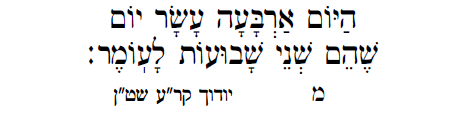
Today is Day 14, which is 2 weeks of the Omer . . . . . . Ha-yom arba'ah asar yom, shnei sh'vuot la-omer.


At the conference I'm attending, we have heard from incredible leaders - former vice-president Al Gore, president of the NAACP, the head of Planned Parenthood, current politicians, Jewish leaders in social action - who have chronicled a bit of their own and their organizational journeys to improve and continue to strive to make the world better.  Just as they have allowed their discipline to enhance their leadership, it is out time to figure out how to do the same for ourselves.  

THE OMER INTERSECTION: Gevurah + Malchut;  Discipline + Leadership
Who knew that discipline could have so many facets?  What seemed at first glance to be probably the most straight-forward and practical of our intersecting values has yielded all sorts of wonderful insights and opportunities for growth.  It all culminates with this last day of malchut, sovereignty/leadership.  The whole idea of working on our discipline - for ourselves and with others - has been a means for us to establish more control over the aspects of our world that we hope to change.  In many ways, gevurah is about becoming, and now that we have gotten to the end of the week, it is important to celebrate what our discipline has led us to become.  Of course, we always have more to achieve, more growth to find.  My engineering brain has been trained to seek out continual improvement.  But without stopping from time-to-time to recognize what our discipline has led us to be, we might continue changing without improving, going down paths of discipline that lead us away from our goals instead of towards them, and we might even get burnt out from the sense that we are doing all this work without seeing the benefits.   

THE OMER CHALLENGE: 
So, how do we apply this idea?  Good leaders must reflect on how they have led and make adjustments.  How many times have politicians adapted new approaches in order to stay relevant and effective?  Or on a more practical level, how many baseball players have changed their swings in order to compensate for changes in hand-eye coordination or injuries?  How many aging basketball players hone their fadeaway jumpshots (I'm looking at you, Michael Jordan) over the course of their careers so that they do not have to put as much stress on their bodies by charging at the basket every possession?  Not only does such an approach help avoid injury, but it also makes for a more complete player - one who can hit a shot when the defender gives him room, or can blow by him to the basket, should the defender get too close.  
Now, it is up to us to make some adjustments for ourselves - to tinker towards utopia, as a wonderful book about the public school system in America discusses.  The reason we build up our forms of discipline was so that we could improve ourselves and reach new goals.  Today is the time that we take to assess some of those goals.  
TASK: Let us take out any list of goals we might have (I'm going to consult my New Year's resolutions I referred to earlier in the week) and fill out a self-assessment.  We have to ask ourselves, "What did/will it take for me to get there?" "Am I on the right track to achieving this goal? If not, what adjustments to my discipline must I make?"  And if we have managed to achieve a goal on our list, then we should ask two questions:
1) How has this made me a stronger, better person?  How has the accomplishment of this goal changed my life or the lives of others?
2) Now that I'm at this plateau, is there any further development I hope to make in this area of my life?

I know that these ideas may not at first glance look like they have a ton to do with leadership, but being able to self-assess and adjust one's behavior to align more with one's values is paramount to one's ability to make similar decisions in the best interest of a company/family/relationship/team/other-venue-of-leadership.  And in the end, doing so frees us a little bit from the feeling that life just happens to us.  Just as I mentioned in the lead-up to the omer, life happens quickly, and it can sometimes feel as though life is just happening to us.  When we discipline our behavior to align with our goals and the person we WANT to be, then we live out our time - we may not control everything around us, but we have the tools to respond in ways that bring life and blessing to this world.

OMER REFLECTION:
Rachel's birthday was a success!  Thank you to anyone who reached out to her - we both get lifted up when we hear from loved ones.  Between the time we spent together and with colleagues and friends and newly acquired friends from across the country who are also at this conference, we have done a lot of yesod, bonding, as well.  And it takes discipline to be able to manage to have time for all the events and the people in such settings.  But what a worthwhile endeavor.
The rest of yesterday's post involved a reflection on the major events of yesterday.  And on facebook, at this conference, even with random strangers in the elevator - sure enough, there has been a lot of bonding over the discussion of what the death of Osama bin Laden means.  Anyone I asked had something to say.  I don't know if this is a shared moment of joy, relief, confusion, justice, or any other label, I just know that the world shared an experience.  And though I know this is a misquote of Dr. Martin Luther King, Jr (only the second half of this statement is his from a 1967 speech, "Where Do We Go from Here"), this snippet I've seen on a few facebook pages offers a summary of a lot of what I've been hearing from people: ‎"I mourn the loss of thousands of precious lives, but I will not rejoice in the death of one, not even an enemy. Returning hate for hate multiplies hate, adding deeper darkness to a night already devoid of stars. Darkness cannot drive out darkness: only light can do that. Hate cannot drive out hate: only love can do that"


And from a Jewish perspective here's another reflection that I agree with in parts and not as much in other parts, but found the read to be quite thought-provoking: 


Now, get ready to move on to a week of . . . tiferet - compassion!

Wednesday, April 27, 2011

Day 8: Moving On to Discipline

Today is Day 8, which is week 1 and 1 day of the Omer. . . Ha-yom shmoneh yamim, she-hem sh'vua echad v'yom echad la-omer.

Mazal tov to all of you who made it through the first week of the omer period.  We now shift to week 2, in which we take on a second of our virtues, Gevurah (discipline), and pick it apart from the various lenses of our Kabbalistic virtues.

In all honesty, this is the week I have been looking forward to exploring from the moment I conceived of this blog.  Gevurah, Discipline, infers judgment.  And when we commit ourselves to do something, we are making a statement that reveals what we have deemed to be important.  It is one thing to SPEAK our judgments and another thing to follow-through with them.  Gevurah is living-out our assessments.  
Personally, I am hoping to improve on my own sense of self-discipline in various areas of my life, and this week should offer me a lot of opportunities to reflect, learn, and grow in order to meet some of the goals I have for myself and to be the person - the individual, the husband, the father, the rabbi, the brother, the friend, the story-teller, the Cubs fan - who I aspire to be.

THE OMER INTERSECTION: Gevurot + Chesed;  We're not quite done with love . . . Where we find love in discipline.
Back on Day 2, we explored the intersection of these same two values, but we did so from the opposite point of emphasis.  Then, we looked at where we experience and express discipline in our loving-kindness.  Today, we are going to flip it around and explore how we experience loving-kindness in the midst of our discipline. 
When it comes to discipline, gevurot, really represents our level of commitment and focus to achieving a goal.  The concept of chesed in relation to discipline speaks to the vision and passion that keeps us going in our attempts at discipline.  We build up a routine of discipline around various behaviors which we find important and valuable, especially when the specific tasks that lead us to our bigger goals require repetition, patience, and step-by-step progress.  It is much easier to follow through with the annoying side of our commitments when we have a solid sense of purpose behind it all.  Often, our tendencies towards chesed reveal our central vision.  For instance, I am blogging every day of the omer.  On a night when I flew home from Florida after saying goodbye to my parents and siblings, dealt with a busy airport, jumped right back into work, and got home late from a board meeting, blogging was not necessarily the first thing I wanted to do.  Sleep has been calling my name since I got into my car to come home, and my bed is a delicious thought, even as I type it.  But, I am attempting to assert my discipline.  And when I remembered this week begins discipline, that this was one of the reasons for engaging in this blog, and that I ultimately wanted to work on my own level of commitment and follow-through so that I can treat my loved ones, my friends, and my community better . . . well, you're reading the results of where my desire to do chesed has influenced my gevurah, my discipline. 

THE OMER CHALLENGE: 
So, how do we apply this idea?  Discipline takes dedication, and at the most difficult times to stick to our goals, it requires a renewal of passion and motivation for why we are committed in the first place.  One of the exercises for today involves exploring the reasons we are dedicated to the various routine parts of our day.  For 24 hours, while performing acts of discipline, reflect for a bit on the bigger ideas behind why we are doing this.  As we identify our motivations, reach down to discover in what way love, chesed, is a source of our commitment - even if it is love of self!  For example, while brushing teeth (hopefully a routine discipline we engage in every day, multiple times per day), think deeply about why we're brushing.  The surface level of reflection should reveal that we brush so that our teeth and gums are healthy. But if we continue to reach towards the ultimate source of love in our rationale, we discover actual insights within the mundane.  Upon reflection, I realize that I brush my teeth so that my teeth will always be there as a part of my smile.  Ultimately, I love to smile and hope that my toothy smile will always be a source of pride and connection to others.  In such a way, brushing my teeth relates to my love for connecting with others and having a positive self image of myself - essentially having love for myself and it is a means towards showing love for others.  
Let us all find the love behind our routines.  And then prepare ourselves to put chesed a bit in the background for a week, until we re-encounter it on day one of week 3. 
 
THE OMER UPDATE:
Wow, I'm really surprised that I have had as much to say as I have written.  So far, I'm hoping that reading this blog is anywhere near as rewarding as it has been to write it.  Ultimately, it is not the reading or writing that has been meaningful, but the reflection and actions that I've taken as a result of those reflections that has made this a very worthwhile few days.
In regards to asserting my leadership as a giver of loving-kindness, I made my list, and I did my best in a busy airport to show kavod, honor, to those who most of the time deal with complaints. It was nice to have a conversation with the woman who checked our bags while waiting for the tags to be printed, and it gave me a few moments to relieve my anxiety of whether or not we would make it through the INCREDIBLE line at the Hollywood/Ft. Lauderdale airport security.  And a Temple board meeting is always a good place to attempt to help others sense the love and respect that I have been fortunate to receive from this community - I hope my attempts came through. 

DAY 7 FOLLOW-UP: Leadership in love list

So, I made a challenge to jot down a few thoughts on what it means to feel loved, so that we can go forth and try to help others feel the same way.  Here's the part of my list that I'm willing to put on public display in this forum:

HOW DO I FEEL WHEN I AM LOVED:

I feel validated.  I feel supported.  I feel lifted-up.  I feel not-alone.  I feel warm.  I feel unafraid.  I feel important.  I feel that I matter.  I feel entertained.  I feel connection.  I feel motivated to do more and be better.  I feel that it is possible for me to do more and be better.  I feel hope that the world can be improved.  I feel that I have partners in making this world better.  I feel like I can take risks and make mistakes and even fail, but that I will be able to continue to learn and grow, and that is okay.  I feel taller.  I feel that it is okay that the Cubs are the Cubs.  I feel heard.  I feel like giving.  

I know that I appreciate it when others help me to reach these emotions through the gifts of their love.  I hope that I've been to pass some of these rewards forward to those I encountered today, and that I can continue to do so even beyond today's experiment.

Tuesday, April 26, 2011

Day 7: Leading with Love

Today is Day 7, which is week 1 of the Omer. . . Ha-yom shivah yamim, she-hem sh'vua echad la-omer.


So, one week into the omer experiment, and we're still going strong!  Today is the last day of our week of chesed, loving-kindness.  Before moving onto discipline, gevurah, we have one last chance to focus on bettering our relationships and the giving part of ourselves.  So, let's make it count!

THE OMER INTERSECTION: Chesed + Malchut;  The Leadership of Love.
Malchut is the virtue that deals with leadership and sovereignty.  We do not often think of our loving relationships in terms of leadership.  There will be a chance to see what it means to be a leader who incorporates chesed, loving-kindness, which is an important quality of a good leader.  But today, we look at this intersection from the opposite emphasis: What does it mean to be a leader in a loving-relationship?  Part of this intersection has to do with recognizing how being loved can make us feel.  Our Jewish tradition teaches us to love God, Who is to be loved as a Leader/Sovereign.  In our relationships, when we feel loved, our spirits are lifted up and we are made to feel important and worthy.  And the hope is that such feelings help us to become more compassionate, more caring, more giving.  
At the same time, we should question what it means to be a leader in a loving relationship.  We should be reminded that sometimes, an effective leader needs to step back and not control every aspect of our world - especially when it comes to dealing with other people.  Each one of us has our own personal needs, stories, and expectations; and when we suppress others for our own gain, we are not being leaders in our loving relationships, we are instead using.  Today, we put together the lessons of the week to take a leadership role in loving others. 

THE OMER CHALLENGE: 
So, how do we apply this idea?  Leadership is much easier to talk about in theory than to implement in practice.  It's a tough one, but based on my reflections above, I've come up with a couple of concrete steps to take.  It is easy to take our relationships for granted, to be a passive participant by letting others relate to us.  So, for today, be an active chesed-giver - reach out to three people with whom we have not recently taken an active role in relating.  Set some concrete plans to catch-up with them and re-kindle the relationships.  
And in terms of feeling love, I know this sounds ridiculous.  But let us take out a piece of paper (or a word file on our computers), think of a few of our most dearly-held relationships, and write down a few thoughts on how we feel when we think of the love we receive.  How does it hold us up, and how does it give us strength?  Now, for the next 24 hours, let us try helping others we encounter experience the same emotional bolstering - whether with a spouse, a sibling, or with the check-out person at the grocery store.  Then, take this piece of paper (or file), and save it for day 43, where we might have a little exercise.   
 
THE OMER UPDATE:
Today was our last full day down in Florida with my parents and my sister, brother-in-law, and their 7-month-old.  It is so very easy to let these brief visits fly by and start preparing for "re-entry" into the normal, everyday realities too early.  Having yesterday's challenge of creating a memory made this day extra special for me, because I was attuned to trying to be present in moments and to capture them in my memory. 
Today, we got to spend time at a playground, watching my 17-month-old daughter interact with her 7 month-old cousin and her Bubby.  I took mental images of Bubby pushing each of these little ones in swings or walking with them, and their huge toothless or barely-toothy smiles as they watched her play with them.  I'll remember taking a walk around the block with this motley crew, doing our first "mom-and-dad swing" with our daughter, and the way that she would "run" with her feet in mid-air as we lifted her up.  And I took a mental picture of my parents putting their granddaughter to bed, as I peeked my head in the room when they were reading her a bedtime story.  The three of them cuddling on a bed, and as Bubby whispered one of the lines of the book instead of reading it, my daughter completed the last word on the page with a whisper, matching the tone and mood set forth by her matriarch.  Today was a good reminder to be fully present in the present with whomever we are spending time.