Friday, June 16, 2017

Israel Day 4: Goodbye to the North, Hello Jerusalem

L'cha Dodi Likrat Kallah, P'nei Shabbat N'kabalah - Come, my beloved, to greet the bride, we will receive her face: Shabbat

These words were written in the mystical city of Tzfat/Tsfat/Safed and start one of the prayers we say on Friday nights,  welcoming the time of Shabbat and the period of rest and reflection. Today, we stood in the streets of Tzfat. Looking out at the majestic mountainside view, we sang this song of Shabbat in anticipation of Shabbat, which we will experience tomorrow in Jerusalem.

The view along today's run ... not as cloudy,  but still beautiful.  I'll miss you, lush mountains! 

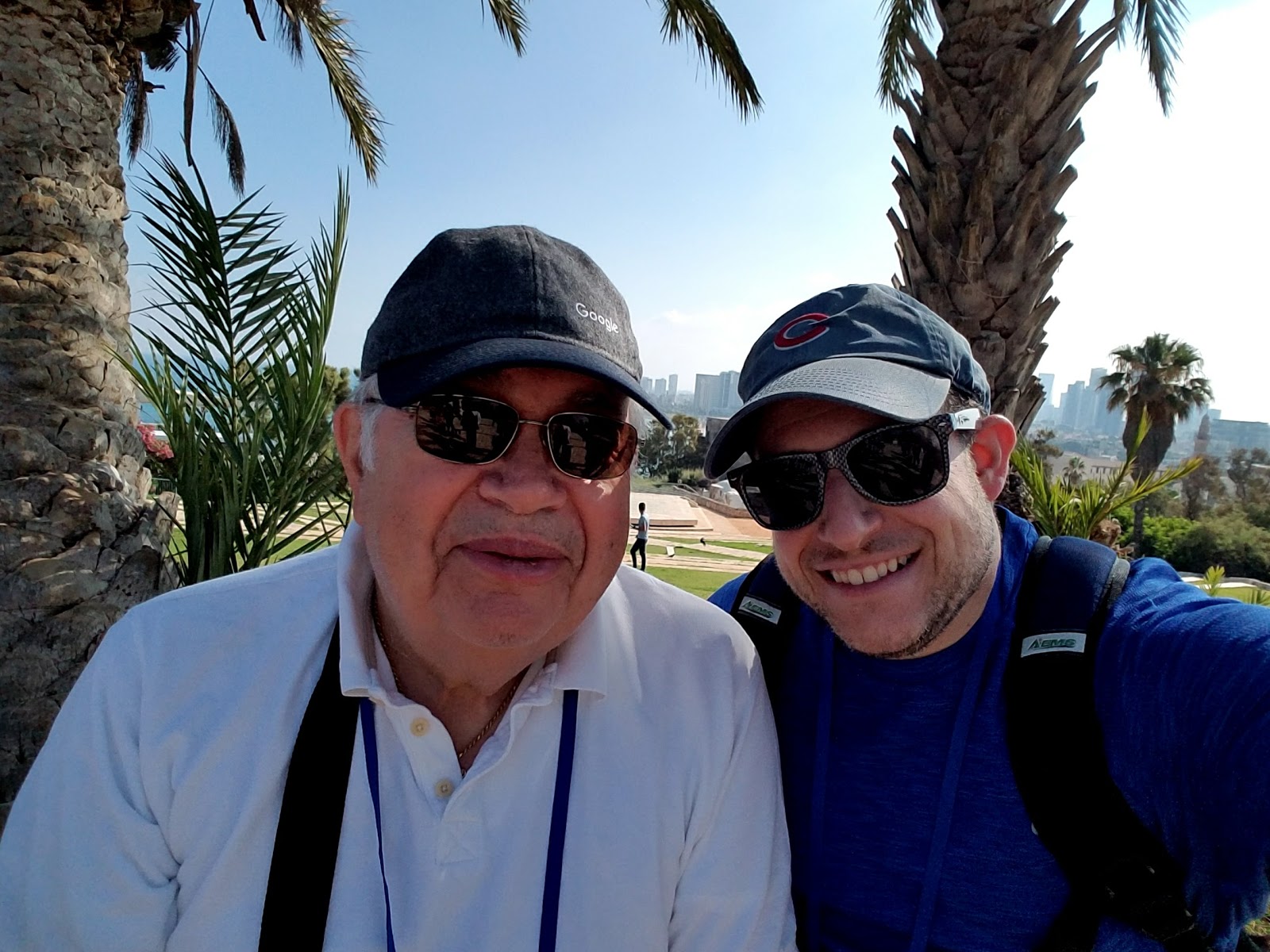
These travelers did not pre - plan their outfits


Also in Tzfat, we meet with a glass blower, Sheva Chana, who have us a demonstration of her craft and a glimpse into the life of an artist in Tzfat. There are still many artists of different kinds in this mystical city which our tour guide,  Shelley, aptly described as "a mix between Berkeley and Jerusalem. "


We also visited some historic synagogues in the area - those of Rabbi Josef Caro and Rabbi Isaac Luria (the Ari...not this Ari). We learned of the innovations to Judaism that originated in this northern city.
Learning how the printing press spread Rabbi Yoseph Caro's book of law, the Shulchan Aruch.


After some shopping and an encounter with a bar mitzvah celebration, it was time to say goodbye to the North and head towards Jerusalem. Driving by the Sea of Galilee, we stopped along the way at the Galil chocolate factory and made our own chocolate bars!


Then on to Jerusalem, where we first laid eyes on the heart of our peoples' narratives. We said a special shehekheyanu prayer, giving thanks for the moment, recognizing how many generations of our people and our families had yearned to be able to see this site. Another fabulous day in the holy land!


Wednesday, June 14, 2017

Israel Day 3: The beautiful North

Mashiv ha-ruach u'morid ha-geshem
The one who shifts the winds and brings down the rain... (from the g'vurot section of the Amidah prayer)

A day of firsts for many of us on the trip. We hiked along the Dan tributary to the Jordan river, we saw an ancient altar site of the northern kingdom of Israel, we off-roaded in jeeps along the Syrian border and spoke with a UN observer atoo Mt. Bental. We rafted down the Jordan river and spent time on the kibbutz where we are staying.

But I have to say the biggest surprise and miracle I noticed was that we had rain ... yes, rain falling from the sky...in June...in Israel. Now, it was only a few drops, and we were not in the desert, we were in the far north of Israel ... but I never expected this. I learned the reason we shift the language of our g'vurot prayer from the language above that expresses our hopes for rain to the language of our summer, morid ha-tal (who brings down dew), was that we don't pray for that which cannot and will not happen. So, for the few drops of water I felt on my run this morning and out at our jeep ride, it felt quite miraculous.

It's a great reminder that you just never know what you're going to get here in Israel ... as for the rest of the day, I'll let the pictures do the talking. Enjoy!

 Bill and Rich at the Dan tributary, one of three main sources of the Jordan river ... literally bringing life to the land of Israel.
 Admiring fig that look kind of ripe on the trees
 The group gets educated about water along our nature hike
 Hailey demonstrates how the land builds up enough pressure to push the water out into these tributaries.
 ....And Jocelyn demonstrates an even BIGGER pressure build up for these water sources. 
 It was part hike, part teamwork, but we all made it through this gorgeous section of the hike called gan eden, or paradise
 Part of the Bat Mitzvah experience is conquering fears and gaining confidence ... so, Jocelyn pushed herself to make it across onto the little island in the middle of this pond. 
 And her proud father joined her on the big moment
 Rootbergs packed into a jeep...just like at home
 I don't know this passes safety standards in the US, but it sure was a lot of fun and filled with a great understanding of the geography of the region
 An obligatory shot in front of a "danger mines" sign .... no Israel tour is complete without one
 In front of a huge crater pond near a Druze village...if you don't know what Druze are, Google them!
 Atop My. Bernal, looking out at Syria in the distance. We were closer to Damascus than Jerusalem! 
 Talking with a U.N. observer from Slovenia. He told us not to ask who is in charge of the village closest to our view in Syria, as it changes all the time as to which rebel group holds it. Most likely, a group loosely affiliated with Al-Qaida. We heard about the impact of the Syrian conflict and some of the challenges in dealing with refugees and the injured, many of whom are allowed in to Israel for treatment  (though the U.N. official could not officially affirm this happens)
 Selfie in a bunker #1 ... looking out onto Syria
 Selfie in a bunker #2
 Rafting down the Jordan river
Some masterful steering by my father helped us pass by the many clueless birthright groups  (and we even rescued a group of Israeli soldiers whose raft was stuck on the river bank)

That's it for now...tomorrow, off to Tsfat and then our entrance into Jerusalem!


Israel Day 2: To the North

I pray that these things never end ... the sand and the sea/ the rush of the waters/ the crash of the heavens/ the prayer of the heart. - Hannah Shenesh

As in most full days in an Israel pilgrimage, this day was packed! So packed that I fell asleep with blog in hand trying to chronicle it all - so it's the next morning here by the time this posts...

Day 2 began in Jaffa, learning history of Jewish immigration from eastern Europe, relationships within Jaffa, and of a movement to create a new city just to the North - Tel Aviv. The city building began in 1909, so this entire urban and suburban sprawl - the heart of Israeli secular culture and innovation (and beach culture) - all cropped up between Cubs World championships!
 The group in front of a skyline of Tel Aviv
A Bill M. #selfiewiththerabbi in Jaffa

From there,  a haunt over to Independence Hall to hear about Israel's declaration if Independence. Sorry to Aaron Burr, but we made it to the room where it happened, where David Ben-Gurion did not throw away his shot (Hamilton reference for those who have not seen it).
Outside the Dizengoff museum in which the State of Israel was declared
While inside Independence Hall, we listened to Israel's origin together with an incredible birthright group - a trip designed for 18-26 year olds with special needs.

Happy to be here!
All around Tel Aviv, gay pride flags are still flying from lat week's 200,000+ person gathering for Tel Aviv' s pride weekend

After a stroll down the earliest parts of Tel Aviv, where the original families first divided up sand dunes to build on, we were off again to Caesaria.

Caesaria is an incredible archeological park that gives a great understanding of the layers of history in this region. We saw Roman ruins, Crusader ruins, Ottoman ruins, ruins from various Christian and Muslim periods, all in one site, the natural harbor of Caesaria.

At this site, we also learned about Hannah Shenesh, the freedom fighter who parachuted into the Nazi empire to fight during WWII, only to be captured and killed. Before this fate of hers, she lived near Caesaria, and she wrote a famous poem, "A Walk to Caesaria," otherwise called "Eli, Eli," that has been put to song - one of my favorite prayers. We sang this prayer together, a prayer of hope and of marvel at the glorious site of a beautiful sea.

At the Roman theater, where they still hold performances today.


My God, My God
I pray that these things never end:
The sand and the sea
The rush of the waters
The crash of the heavens
The prayer of the heart

By the way, if you told me we'd be in Caesaria at noon (after many trips to Israel, I know there is NO shade in this site), I'd have changed the itinerary. But the weather was mild and wonderful!

At lunch in a mall ... Jocelyn declared that her ice cream spoon is like "a shovel for a grasshopper." Apt description, indeed.

After lunch where some found a kosher McDonald's that has a meat side of the counter and a dairy side of the counter, we were off again to an ancient acuaduct that brought water to Caesaria. Connecting to a natural underground source, the Roman builders carved a tunnel through the hilly terrain, always sloping down, leading to the acuaduct system that brought fresh water, hence life, to Caesaria. With flashlights in hand  (every other hand ... long story), and teamwork in our hearts, we spelunked through part of this underground water passage. Experiencing water slightly above our knees  (and at other times, way more than slightly above), we learned about ancient engineering first hand.
Passing through one of the shafts leading down to the waterway... we started singing the Indiana Jones theme song 
Deep in the tunnels ... we started singing, "Hi hi, it's off to work we go."
I forced everyone to look into the sun, trying to get a shot of the shaft we climbed out of 

And then it was on to the North, my favorite scenery in Israel, to the kibbutz from which I am writing you, Kfar Blum. Another day of adventure, of learning, of connecting and of great food in tow.

And of course, it was a special day ... it was Sallie's birthday!  If you haven't yet done so, please go to her Facebook page and wish her a happy birthday!

A birthday #selfiewiththerabbi for Sallie - it was a memorable one!


On a personal note: I have a goal of running every day of the trip (except maybe Masada day, when I might save energy for a hike up and/or down). I'm using this blog as an accountability source, to help motivate me to stick to the goal ... so far, 2 for 2!
I paused on my run to take a shot of the site on the beach where we joined together for a Shabbat morning service during my last trip to Israel
My phone wouldn't rotate the pic, but here's the view from my run this morning in the North 
I found it, Shel Siverstein ... where the sidewalk ends.
Maybe  it the most flattering picture, but this was a total accidental selfie, which is incredibly framed! 


Monday, June 12, 2017

Finding Promise

I'm sitting here on the beach of the Mediterranean Sea in Tel Aviv, completing our first day of travel as part of our Or Shalom Israel adventure.

The weather is PERFECT, the sounds are a mixture of waves crashing, techno dance music blaring from the various clubs nearby, and the smattering of car horns typical of any city here in Israel. The breeze is cool and constant and brings the salty, humid taste of the sea with it.

The Jewish people have called this place the Promised land, particularly using such nomenclature during times we could not be here. So, now that the Jewish people can live here, what does that promise mean?  This is a question we are here to explore. Is it the promise to have a place we can call home? Is it the promise that we can earn the opportunity to stand here if we promise to promote values of justice, equality, freedom and peace? Part of this journey is the chance to figure out what this promise means for each of us, now that we are here and Eretz Yisrael is not just a yearning, but the place in which we stand - a place of hope for many people.

Our wonderful tour guide, Shelley Trachtenberg, framed this question we'll be exploring with this poem from Israeli poet Amos Oz, called "Leaving a Mark":

The land of Israel is not a Museum of God. No place is a museum of God,
No person and no inanimate object is a thing of worship. 
It is permissible to both touch and change these things 
On condition that you yourself are prepared to be touched and be changed. 
The condition is love. 

I know: it is impossible to 'educate to love' --
You cannot educate someone to love the Land, 
Nor can you educate someone to love the scenery. 
With love, you can "infect" someone else. Sometimes love can be awakened, Sometimes, but not with a strong hand, not with an outstretched arm, and not with burning anger -- 
rather through an approach of mutuality. 

You come to a place -- a hill, the desert, a spring, a house... 
You can change it and make your mark upon it, 
But it is also important to be open 
And give it the opportunity to leave its mark on you.

Here's to understanding this complicated, amazing part of our world and finding the promise it holds for each of us - in our hearts and in our hopes.
Pictures below (on my phone,  I just can't seem to embed the pics in the text ... yet):
 First group selfie
 Reunion with my parents and a lovely family friend, Dov
 Incredible sunset on Tel Aviv beach
 Our first group shot prior to heading to a delicious Mediterranean dinner at Maganda
The view of Tel Aviv, Old Jaffa, and the beach from where I'm writing this on a gorgeous evening! 


Friday, June 9, 2017

Leaving on a Jet Plane ....

Sunday, I'll be embarking on an Israel adventure together with part of our Or Shalom family.  I'll be updating this blog with pictures and insights from our journey so that you can virtually follow our adventure to our Jewish homeland. See you in the Promised Land!

Friday, January 20, 2017

Ehyeh-Asher-Ehyeh: A commentary on the times and our Torah portion of Shemot


Ehyeh-Asher-Ehyeh.
I Will Be That Which I Shall Become.
As Moses journeys in the wilderness, shepherding the sheep at his charge, he notices a bush that was on fire. Rather than run from it in fear, Moses draws near enough to realize that its flames continued to burn without consuming the plant. The voice of God calls out to Moses from this bush, revealing to the future leader of the Israelites a Name for the Divine Presence.
Ehyeh-Asher-Ehyeh,
I Will Be That Which I Shall Become.
As Moses listens, he learns of his own destiny as the leader of the Israelite revolution that will overthrow the Pharaoh of Egypt and free the Hebrew slaves. During a time of fears and inequality, Moses is to become an instrument of freedom and justice. He will learn to stand up and become the voice for others, even as he fears that his own imperfections will get in his way.
Moses learns that he, too, will be that which he can become.
Ehyeh-Asher-Ehyeh.
This name of God reveals an uncertain certainty for the future. We cannot always predict the future or know exactly the role we will play in the long story of our people. But throughout our texts, God has emerged to help inspire prophets and individuals to get up, to stand up, to speak up for those who are most vulnerable during times of great changes. God has encouraged each of us to embrace this name,
Ehyeh-Asher-Ehyeh,
I Will Be That Which I Shall Become.
When God is not revealing God's self as that source of hope, there is an expectation that we can become the mouthpiece for God - being unafraid to show the world what it can become, not resigning ourselves to accept the way things are. Like Moses and the prophets before us, may we embrace the spirit of God's name, striving to be more than the voices of intolerance, anger and selfishness that surround us. May we spread a message of hope and a vision for justice in word and in deed. May we strive together to build a future that we can look upon with pride, as Jews, as Americans, as Children of God.
N'hiyeh-Asher-N'hiyeh.
May We Be All That We Can Become.

Friday, November 11, 2016

Journeying Forward


Lech l'chah, you will go forth on a journey...

This week's Torah portion speaks of the journey that Abram and Sarai (their names before they became Abraham and Sarah) embarked upon in order to reach their destiny, becoming the progenitors of the Jewish people and of the values that have shaped our world. Journeys of change are never easy, they involve letting go of expectations and assumptions, facing unforeseen challenges, embracing unexpected outcomes. However, as our Torah teaches over the next few weeks, journeys are critical to our abilities to become, to transcend, to grow.

Our country is in the midst of a journey - one that was started before this week's election results. This long and bitter campaign has brought forth many feelings, many perspectives, many painful words from all sides of the political spectrum. Regardless of the election's outcome, our society had already left what many of us had assumed it to be. Frustrations and hopes of all kinds had come to the surface in a cacophony of voices, unsettling us whether right or left or in between. We have become a nation who no longer knows one another, losing its grounding in shared values and ideals, focusing instead on what divides us. This way is untenable, and therefore, a journey is necessary.

Some of us are disappointed or frightened by the outcomes of the vote, worried that words that have denigrated parts of society and voters who carry with them prejudices and biases against sections of our society (including our Jewish community) will lead to the actions of our future. To this view, our Torah portion reminds us that one way to overcome such concerns is to reach out in relationship to those beyond our inner circles. Abram and Sarai enter a land where they knew no one. They feared being judged unkindly and even killed (which is why Abram introduced his wife as his sister to the foreign king ... long story). They remained vigilant as to the threats that arose around them, they advocated for what they knew was right (even standing up to God for what they believed). As they interacted with others in accordance to their core values and with respect for others, they were able to help transcend their fears and build a better world around them. Eventually, when Sarah passed away, the neighboring people so wanted to help Abraham, they were willing to give away land for her burial. We are already on this journey, abandoning hope is not an option. 

Others among us are excited or hopeful or optimistic or relieved by Tuesday's results. We may or may not agree with every element of the agenda that has been espoused, but think the country needed a new direction, fiscally or politically. We have responsibilities, as well, to welcome others into our tents, to listen to the fears and ideas of our neighbors and seek truth from all sources, allowing space for all voices. Abraham and Sarah learn of the fulfillment of their dreams only by speaking with the strangers they welcomed into their home and treated with kindness and care. Assuming nothing about these wanderers from their backgrounds or what they wore or what accents they had - only assuming they were made in the image of God like the rest of us and would need food and drink in the middle of their desert wandering, Sarah and Abraham allowed these three messengers from God to shape their journeys for the better. If we wish our communities and this country to come back together, we have to be open to those we do not know or who disagree with us politically, not assuming the worst of others, but finding ways to love and appreciate their humanity. We cannot complete this journey alone.

Whatever our reactions, our journey has already begun. The question for all of us now becomes, how will we respond? We all have to accept the reality that 1 out of every 2 people in our country chose a different candidate to lead us on this journey. More individuals chose one path, more states chose another. This divide demands of us to notice and acknowledge the hurt and pain that has been caused on all sides during this campaign, and have some sensitivity to one another. And perhaps we have to find a way to end the blame game of who caused what and instead focus on what we can now do together. This moment in time requires us all to look in the mirror and question what we need to let go of and what we need to hold on to in order to be a part of what we might become. 

Ahead lies our journey - once we mourn our lost expectations or celebrate our victories or contemplate in confusion what just happened, it is time for us to go forth like Abram and Sarai with trepidations, hopes, and fears. We have already left home. We must reach out to others we do not ordinarily talk to. We must be vigilant and be aware of hate and misogyny and labeling and prejudice that surround us. When we notice, we have to advocate for others and for ourselves, these are our core values as Jews. We all have an obligation show our disgust at the fringe hate groups who are reveling in our nation's choices, and we have to hold our leaders accountable and demand that they join us in shunning those who seek to divide us even further. 

We cannot bury our heads in our disappointment that the end is nigh, nor can we live in a euphoric fantasy that all is going to be just fine, now. Change takes effort and work. As we spoke of at the High Holidays, what defines us is not the world around us, rather we are defined by the ways we respond to that world, finding the strength to be our best selves, adding love and justice and respect to the world through the journeys we live. Let us start locally, showing kindness and respect to those around us in our Or Shalom community and in our neighborhood communities. Let us lift one another up and make one another better, giving us all strength for the journey ahead. This is what we will begin to do at our Veteran's Shabbat service this Friday night. This is what it will take if we wish to be successful in our journey to make America greater and stronger together.

Friday, October 28, 2016

An Ode to the Intersection of Bereshit and My Beloved Cubs


An ode to the intersection of this week's Torah portion, Bereshit, and my beloved Cubs:

In the beginning. . . 
There was a team that experienced an abundance of success. They went to the World Series three times in a row. But they fell from grace after two straight championships. Expelled from the Garden of Greatness, they lost their way, squandering opportunity after opportunity. They experienced a deluge of misfortune, a famine of talent and success as they turned away from the land of the World Series, winding up in the bondage of ineptitude. They wandered, searching to find the promised land for 71 years, escaping the oppression of poor management and indifferent ownership, never losing hope. 


Suddenly, a new team arose who knew not the Cubs of the past. Together with new ownership, sabermetric analysis, young talent, and innovative management, the long suffering crew has found its way to back to the World Series, standing on the precipice of the promised land. 

By next week, we will all know the outcome of this part of our story, yet to be written. But what we do know is that sure enough, a new baseball season will come next Spring with new opportunities for redemption, renewal, and understanding, just as we have opportunities to find the same in our own hearts during this next year of reading our Torah. 

Here's hoping that the team that taught me to understand the narratives of our people, always striving to return home to the promised land, will have found their Jerusalem. And whether they do or not, as we say at the end of Passover ... Next year in the World Series! 

Friday, July 22, 2016

Looking Past the Opinions

I know it has been a while since posting... Rabbinic life has been busy!  There are too many situations around us for which there have been no words.  So, I felt compelled to post once again - we'll see if this becomes a regular habit... For now, here are the words of Torah that I sent to my congregation this week.

            There are a lot of words flying around at us these days. It can be difficult to discern truth amid the itchy blanket of opinions that has been thrown over us. How are we supposed to know what and who to believe?
            
In this week’s Torah portion, the foreign prophet, Balaam, struggles with a similar dilemma. The Moabite King, Balak, commissions him to put a curse on the Israelites. Despite pledging that he will only say the truth that God puts in his mouth, Balaam attempts to override his prophetic methods and listen to the opinions of Balak. He first sets out and must be reminded by a talking donkey that there is such a thing as truth. Attempting to chart his own course and ignoring all that he had learned to that point, Balaam almost ran into his own demise. His trusty donkey saved his life by stopping right before an angel of God, ready to smite Balaam in the midst of his rebellion. And how did Balaam thank the donkey? By beating him. Only then, did this animal speak, reminding Balaam, “How long have I been your steed? Have I ever done anything like this before?”
            
This donkey made Balaam take a step back and think. He reconnected with his core values instead of allowing himself to get swept up in the rhetorical pressures of the king with a nefarious agenda. It was only then that Balaam could remember what allowed him to find truth in the first place – not by imposing it upon the world, but by paying attention and noticing, by using evidence and assessment. So it was, despite setting out to fulfill Balak’s request, even after the donkey and angel incident, that Balaam opened his mouth to speak. And as the rabbis teach, when he saw the Israelites’ tents – how they were arranged to allow for respect for one another and equality – he found the truth that existed and shined brighter than the opinions that were being thrust at him. He instead said the words, “Mah tovu ohalecha Ya’akov? Mishk’nothecha, Yisrael?”  How beautiful are your tents, O Jacob? Your dwelling places, O Israel?
            
These words have become a source of blessing for us, still today, as they make up a traditional morning prayer recited daily. This beautiful prayer only came because Balaam was able to put aside the pressure-laden, judgmental opinions being thrust upon him by a king with an agenda. Balaam used his own eyes, his own thoughts, and most importantly, his own core values to assess the situation and see what truly lay before him.
        
May we each find the strength to open our own eyes and see beyond the partisan, agenda-filled rhetoric that has filled our lives these days. May we find ways to see goodness, may we continue to respect the lives of all people in our society, and may we attempt to fill the world with a light so bright that it shines greater than the voices that have been tearing the fabric of our society apart.

Friday, September 18, 2015

Elul Cool-Down (in Tishrei)

Elul Cool-Down: Connecting

We have started the New Year, we’ve already reflected, and we’ve imagined our dreams for the year we hope to see. Now is the time for our cool-down to carry our Elul workouts into the year we have started; time to figure out which connections we hope to make.

Macintosh HD:private:var:folders:bp:_xzvfmrn3zdfxlrqs7rmgz4w0000gn:T:TemporaryItems:Workout2.png- What is one way I can more deeply connect with each of my loved ones in my family in this New Year?  Will I read more to my children? Will I carve out a few extra minutes each night for my spouse before we go to sleep?  Spend a few moments figuring out how you might proactively deepen your connections with those you love, even when your connection might already be great.

- What is one way I can more deeply connect with myself in this New Year? This time of year is about reflection and growth.  Now that we’ve identified the person we hope to become, what will get us there? How do I connect with the inner me?  Will I read a few books I hoped to get to?  Will I carve out running time to clear my head?  Will I invest in my Jewish traditions that help center and ground me?  How can you make sure to keep your “you-ness” throughout this year?

If we can find points of connection this year, I’m certain it will be an incredible New Year for us all.